BLM Determination of Common Variety report (2024)
and U.S. Dept. of Interior Decision (2025)
Determination of Common Variety
On Jan. 31, 2024, the U.S. Bureau of Land Management released its long-awaited Determination of Common Variety report for the Rocky Mountain Industrials limestone mine.
The Determination report, or DCV, shows that the majority of RMI’s limestone sales from 2016 to 2024, and for its proposed mine expansion, fail to qualify under the Mining Law of 1872.
The Citizens’ Alliance contended for years that RMI has been mining limestone for purposes far afield from its permit for mining on federal land, which is based on a narrow list of uses allowed under the Mining Law of 1872.
In releasing the DCV, BLM Field Manager Larry Sandoval said, “BLM has determined that a majority of the material is not disposable under the Mining Law of 1872 because of being marketed for common purposes.”
For example, the DCV notes that RMI’s expansion proposal “provided no evidence or data that substantiates that this [limestone] deposit has unique or special properties that set it apart from other deposits that are used for aggregate for the same purposes.” (DCV page 47)
The agency’s position marks a pivotal point in its review of current mining at the Transfer Trail quarry and of RMI’s massive proposed mine expansion, said Jeff Peterson, president of the Citizens’ Alliance.
If RMI’s end uses for the mined limestone had qualified under the 1872 Mining Law, the company would have few regulatory limits on environmental and economic impacts, and would have no obligation to pay royalties on its sales.
At the time of the DCV release, January 2024, BLM’s Sandoval noted that the agency did not consider the DCV report to be a decision, thus it would not be eligible for appeal.
Dept. of Interior decision
On Jan. 3, 2025, the U.S. Department of Interior issued an official decision letter notifying RMI that mining of “common variety” limestone at the quarry must stop, and the company must pay the government the established value of the common variety limestone sold over the past six years. The decision letter was signed by Steven Feldgus, principal deputy assistant secretary for land and minerals for the U.S. Department of Interior. (Feldgus is no longer with the agency.)
RMI had shut down mining operations at the quarry in December 2024, and in January 2025 it dismantled and removed some of its mining equipment. The metal building, a conveyor and other equipment remains on the site.
Interior’s decision officially halted mining at the quarry. To restart the operation, RMI will have to apply for and obtain a mineral materials sales contract from BLM.
Interior’s decision also set a 30-business-day deadline for RMI to remit to the federal government funds that accumulated in an escrow account from 2019 to 2024.
On Jan. 30, 2025, RMI paid $138,593.74 to the BLM from its escrowed account to cover sales of common variety limestone. The company also sent a letter to BLM noting that the payment was being made under protest, and complained about numerous requests made to meet with BLM officials to discuss the findings of the DCV.
Most end uses appear to require sales contract
The DCV disqualified from protections offered under the Mining Law of 1872 almost all end uses put forth by RMI, such as rock dust for coal mines, road base, rip-rap, structural boulders and chicken grit.
Mining and sales of these non-qualifying uses must be approved under a BLM mineral sales contract, which entails a process that would include public review.
The DCV singles out just one possible exception that would qualify under the 1872 Mining Law: the use of high-quality limestone in adjusting the chemical balance in cement for airport runways.
BLM has provided no evidence in the redacted DCV to show that RMI has sold any limestone for that purpose. However, in paying out its escrow account, RMI retained $10,897 in sales for that purpose. BLM has refused the Alliance’s many requests to produce RMI’s sales records to verify these assertions.
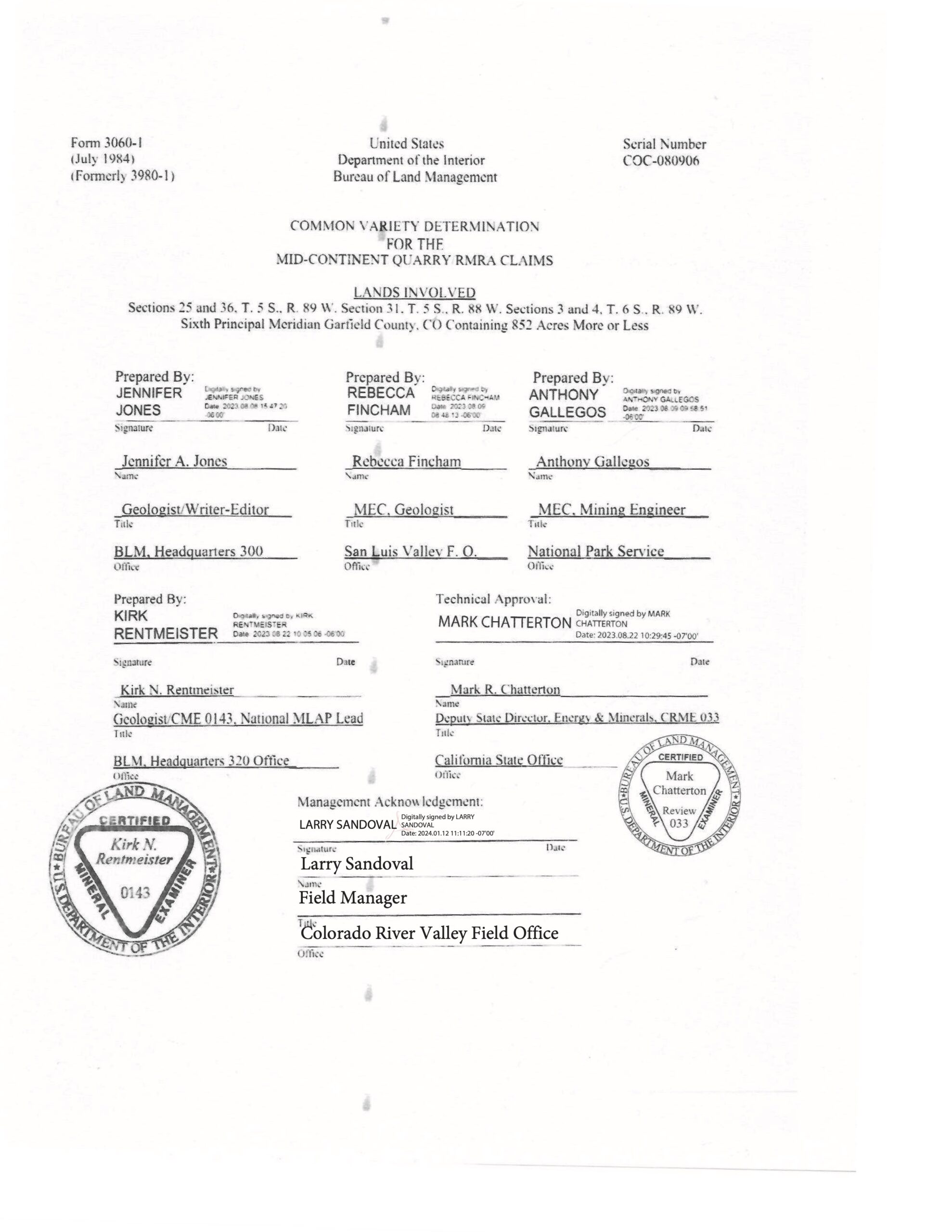
The cover page for the Common Variety Determination report, dated Jan. 12, 2024.
The report was researched and written by:
• Kirk Rentmeister, geologist and certified mineral examiner, BLM Washington, D.C. office
• Rebecca Fincham, geologist, BLM San Luis Valley Field Office, Colorado
• Anthony Gallegos, mining engineer, National Park Service
• Jennifer A. Jones, geologist and editor, BLM Washington, D.C. office
• Technical approval by Mark R. Chatterton, deputy state director, BLM California state office
• Management acknowledgement by Larry Sandoval, field manager, Colorado River Valley Field Office, Colorado
RESOURCES
Redacted Determination of Common Variety (DCV) report
Caution: large file size: 205 pages, 29 MB
DCV cover letter ordering RMI to pay funds in escrow, Jan. 25, 2024(2 pages, 1 MB)
BLM Memorandum discussing legal findings related to limestone as a locatable or common variety mineral (6 pages, 184 KB)
U.S. Department of Interior Decision, Jan. 3, 2025
RMI escrow payment letter and protest to BLM, Jan. 30, 2025
The BLM Determination of Common Variety (DCV) affirmed the Citizens’ Alliance longstanding argument that RMI’s limestone sales did not qualify for protections under the Mining Law of 1872, and should be subject to a mineral materials sales contract.
However, much of the DCV released to the public has extensive redactions, from portions of paragraphs to entire pages.
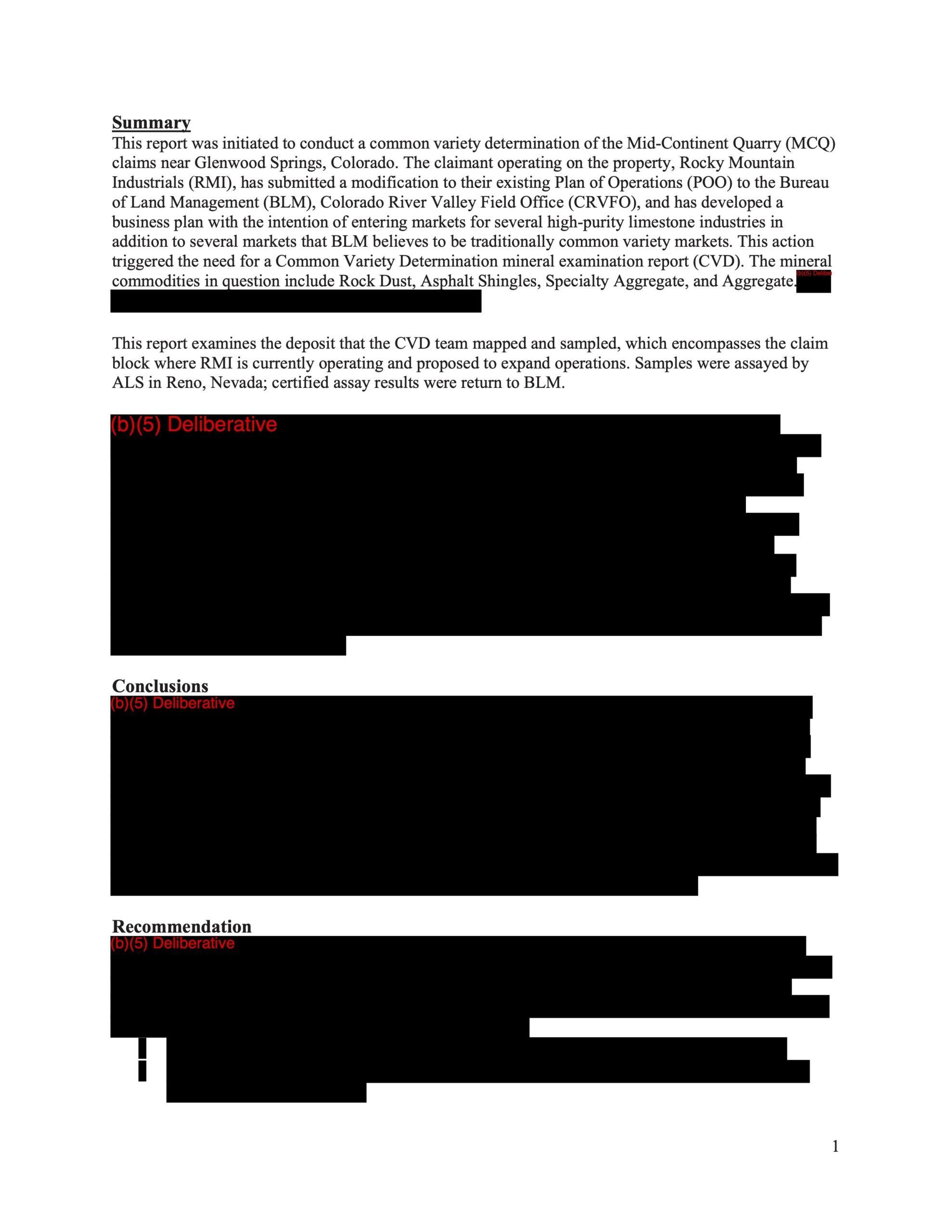
Page 10 of the Determination of Common Variety report, at left, showing blacked-out sections, called “redactions.”
About half of the contents of the DCV released to the public on Jan. 31, 2024, were blacked out, including narrative, tables, maps and photos.
Of the 205-page report, 75 pages were fully blacked out with redactions and another 23 pages were partially redacted.