U.S. Bureau of Land Management Permit Enforcement
What’s New
On June 26, 2026, BLM announced that the third attempt by RMI to submit a mining plan for its mothballed limestone quarry was complete. The proposed plan would:
- More than triple the company’s federally-approved acreage, from the current 16 acres to 56.
- Expand the mine hundreds of feet upslope from the existing quarry.
- Blast out the unstable overhanging cliff that remains from the 2023 collapse of the quarry’s west headwall.
- Mine more of the slope above the headwall.
- Address longstanding permit noncompliance issues.
The current proposal does not address the company’s 2018 plan for a massive mine expansion, although RMI has never withdrawn that proposal.
The company ceased active mining operations in December 2024, but has continued to pursue a revived mining permit, submitting applications to BLM in January and December 2025.
BLM staff will now conduct a technical review of the proposal to evaluate its impacts on other resources.
Background
When Rocky Mountain Industrials (RMI) first purchased the quarry operation in 2016, U.S. Bureau of Land Management (BLM) officials informed the company that several compliance problems carried over from the previous mine operator, CalX Minerals. (The quarry is on public land managed by BLM.)
BLM gave RMI a temporary pass on dealing with permit violations. The agency agreed that the violations could be remedied “within a reasonable amount of time.”
In 2018, RMI announced plans for a massive expansion, proposing an expansion from the permitted 16-acre quarry to a mine of 321 acres on a total permit area of 447 acres. Mining would take place over 20 years at the rate of 5 million tons per year. The controversial plan included proposed remedies for the longstanding permit violations.
2019: Launch of DCV study, Test Drilling, Escrow Account
On Aug. 12, BLM announced it had accepted RMI’s third mine expansion proposal as complete, and pledged a thorough public review. Prior to launching that process, BLM would conduct a mineral examination, also called a Determination of Common Variety (DCV). The DCV study would evaluate two aspects of the mining proposal: the chemical composition of the limestone deposit across the proposed mining area, and the prospects for RMI to market the limestone for a narrow range of purposes allowed under the Mining Act of 1872.
In October, RMI proposed drilling five test wells on the slope above the quarry to learn more about the mountain’s groundwater system. The community raised serious concerns that the test well holes could puncture and disrupt the delicate groundwater network of aquifers that feed local hot springs. An outpouring of 250 comments called on BLM to slow down and study the drilling plan through an Environmental Assessment process.
On Dec. 5, 3rd District Congressman Scott Tipton sent BLM officials a letter underscoring the call for further study.
On Nov. 19, BLM required RMI to establish an escrow account to hold mineral fee payments for its limestone sales. These funds would be owed to the U.S. Treasury if the DCV determined that all or part of the limestone sales did not qualify under the Mining Law of 1872.
On Dec. 12, BLM announced it would conduct an Environmental Assessment to analyze the drilling plan.
2020: In a Holding Pattern
Onset of the Covid pandemic stalled RMI’s push for fast-track approval of the expansion. BLM action to process the mine expansion application was “in a holding pattern” while work continued on the DCV. The agency did not launch the Environmental Assessment process to evaluate impacts of drilling the test wells. Mining continued at the quarry, and the longstanding permit violations continued.
2022: BLM Enforcement Action
On Aug. 30, after six years of continuous mining operations, BLM sent a Noncompliance Order and a separate Notice of Noncompliance to RMI, citing five compliance issues at the quarry and calling for a modified mining plan of operations.
On Oct. 7, RMI submitted a modified plan of operations. After reviewing the plan, BLM deemed it incomplete.
2023: Slope Collapse, Geotechnical Report
On Jan. 6, RMI submitted a second plan of operations proposal.
On Jan. 18, a massive slope collapse occurred at the quarry. Jump to this page for details. LINK
On March 6, BLM issued an Amended Noncompliance Order. “Because the operation’s current conditions substantially deviate from the approved plan of operations, BLM has determined that this is a significant violation of its surface management regulations.”
In April, RMI submitted a third plan modification proposal.
In May, BLM deemed the plan complete except for the absence of a required geotechnical report, needed to address the changed conditions at the quarry following the Jan. 18 slope collapse.
On Aug. 30, RMI submitted the geotechnical report. It mentions rock bolting as a means of securing the overhanging cliff that remained after the slope collapse, but described a preferred solution of mining upslope.
> Find a summary of the Kilduff Underground Engineering geotechnical report, along with links to the report and its appendices, on this page.
2024: DCV Completed, RMI Appeal, Renewed Noncompliance Enforcement
On Jan. 25, BLM released its Determination of Common Variety report, a five-year effort by a five federal minerals experts.
- The document concluded: “BLM has determined that a majority of the material is not disposable under the Mining Law of 1872 because of being marketed for common purposes.”
Learn about the DCV report here. LINK - BLM also issued a letter to RMI requiring the company to tally the funds in the escrow account and remit payment within 30 days for all mined material that did not qualify for protections under the Mining Law of 1872.
On Feb. 23, RMI challenged the findings of the DCV in a filing before the U.S. Interior Board of Land Appeals (IBLA).
On March 8, RMI sent a letter directly to BLM, refusing to pay out the escrow and questioning many points and principles in the DCV.
On March 25, in a filing with the Interior Board of Land Appeals (IBLA), BLM asked IBLA to set aside its Jan. 25 letter ordering the escrow payout and to send the matter back to BLM “to engage in further discussions with appellants.” BLM declined to set aside the DCV itself. IBLA approved the request on April 5.
On April 19, BLM revived its permit enforcement, requiring RMI to submit a revised Plan Modification, asking the company to explain its plans to stabilize the slope, including any new ground disturbance. RMI failed to meet a May deadline for this submission.
In July, RMI made several requests to meet with BLM officials, seeking to press its objections to rock bolting, the escrow payout and its longstanding noncompliance citations. BLM rebuffed these requests, but sought information about limestone sales from the quarry.
On July 26, RMI submitted a draft Modified Plan of Operations.
On Aug. 14, RMI informed BLM that it had obtained verbal approval from MSHA of its proposed mining plan, and would submit a final plan in September. (It was eventually submitted in January 2025.)
On Sept. 3, BLM State Director Doug Vilsack informed RMI that the agency was “contemplating further action in reliance on the DCV report” and again asked for limestone sales information related to runway construction at the Grand Junction airport.
At this point, attention shifted to the Colorado Division of Reclamation, Mining and Safety. The state agency sought a new reclamation plan that dealt with the overhanging cliff and proposed an increase in the company’s reclamation bond. Jump to this page to learn about the state DRMS reclamation plan and bond process, which was completed in 2026.
In December, at an impasse with BLM, RMI closed down the mining operation and laid off most employees and contractors.
2025: U.S. Depart of Interior Decision, Escrow Payout
On Jan. 3, the U.S. Department of Interior issued a formal decision referencing the findings of the DCV.
Mining of “common variety” limestone at the quarry must stop until the company applies for and obtains a mineral materials contract. The decision again ordered RMI to pay out the escrowed funds for common variety limestone sold since 2019.
On Jan. 17, contractors were observed dismantling the milling facility, loading hardware onto trucks that headed west on Interstate 70.
On Jan. 30, RMI paid out $138,593 from its escrow account “under protest.” It withheld $10,897 in fees for limestone sold to a contractor building a runway at the Grand Junction airport.
On Jan. 31, RMI submitted a revised mining plan of operations. It included a proposal to expand the quarry footprint to 56 acres, allowing the company to mine upslope to resolve the slope instability problem.
On Feb. 8, BLM rejected the proposal, citing 17 issues that it failed to address. The agency released the letter to the public on Feb. 28. Find it here.
On Dec. 23, RMI submitted another revised mining plan of operations. It again included a proposal to expand the quarry footprint to 56 acres.
2026: Plan of Operations Complete, Technical Review
In January, BLM found the December 2025 plan lacking, and informed RMI about elements needed for it to be deemed complete.
On May 29, RMI submitted its third revised mining plan of operations. It proposed expanding the quarry footprint to 56 acres and, according to BLM, addresses the slope collapse and the quarry’s longstanding permit noncompliance issues.
On June 26, BLM announced the proposed mining plan of operations is complete.
BLM will launch a technical review to evaluate the plan’s impacts on other resources. There is no timeline for the technical review. BLM will not release the proposed plan until the technical review is complete.
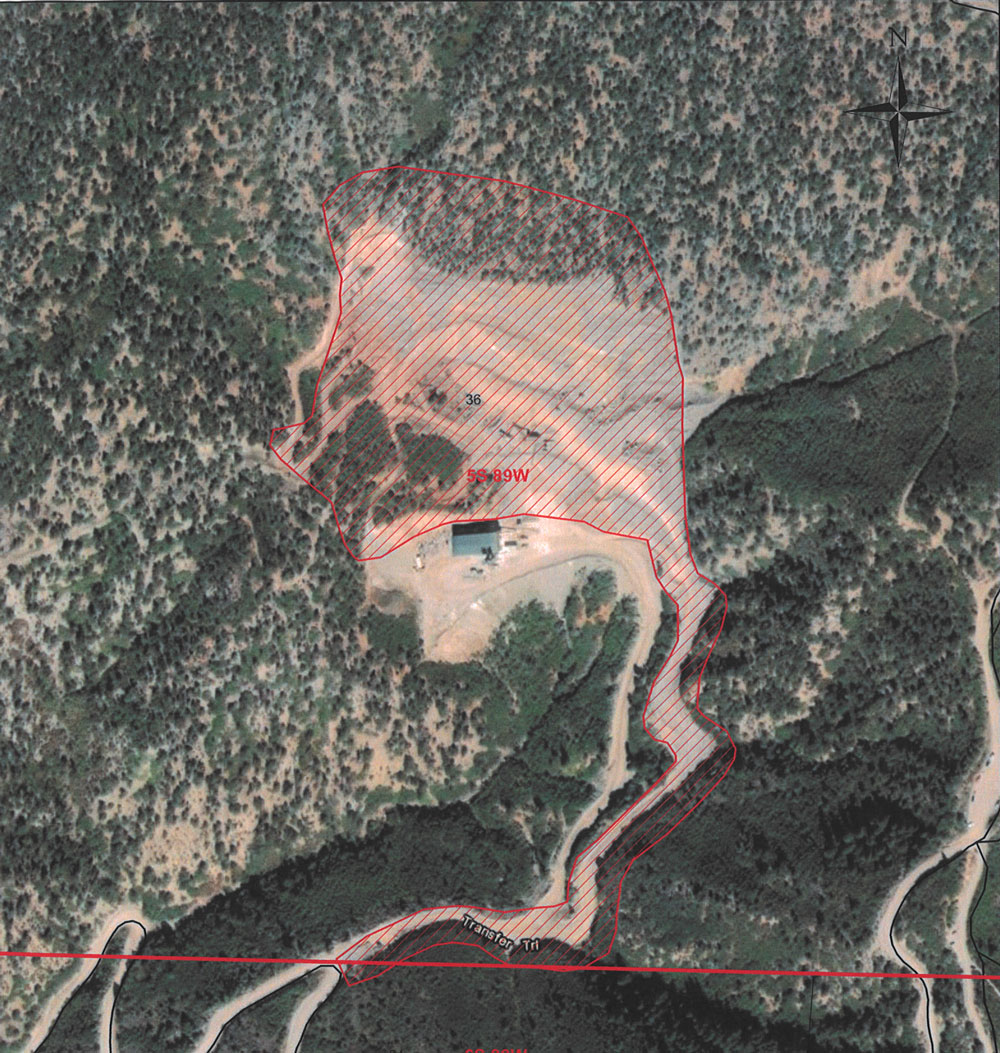
The red cross-hatched area layered onto this aerial photo shows the boundaries of the limestone quarry as authorized in RMI’s federal permit.
The lower bench of the quarry, the mill facility and the lower access road (to the left of the permitted access road) are all outside the federal permit boundary.
Image from U.S. Bureau of Land Management, 2022
Permit Noncompliance Issues
The milling bench, where the metal building is located, and the access road from Transfer Trail are outside the mine’s permitted boundaries.
The milling facility is being occupied and used without BLM approval.
Structures to contain stormwater were built outside the approved plan area and without BLM approval.
The highwall configuration did not comply with the approved plan. (This problem would ultimately lead to the slope collapse in January 2023.)
The topsoil storage pile, located on the mill bench, is inadequate for future site reclamation, and is too steeply graded to avoid erosion.
Enforcement process documents archive
BLM Noncompliance Order 3809, Aug. 30, 2022
This document cites the four problem areas in RMI’s current quarry operations
BLM Notice of Noncompliance 3715, Aug. 30, 2022
This document focuses on the crusher mill being located outside the mine permit area.
BLM response to RMI’s 1st proposed Plan Modification, Nov. 9, 2022
BLM response to RMI’s 2nd proposed Plan Modification, Feb. 3, 2023
BLM Amended Noncompliance Order, March 6, 2023
BLM revised response to RMI’s 2nd proposed Plan Modification, March 7, 2023
RMI’s geotechnical report, prepared by Kilduff Underground Engineering, Aug. 30, 2023
Click here for Determination of Common Variety report documents, Jan. 25, 2024
BLM letter to RMI calling for revised Plan Modification submittal within 30 days, April 19, 2024
Click here for the Colorado Division of Reclamation, Mining and Safety (DRMS) reclamation bond page
U.S. Department of Interior Decision: Determination of Common Variety Report, Escrow Agreement Account Distribution, Jan. 3, 2025
RMI letter: Protest of payment to BLM from escrow account, Jan. 30, 2025
BLM Completeness Review with 17 points to remedy, Feb. 28, 2025