Mining poses irreversible risks to the fragile hot springs network
How the hot springs work
The mountainsides on the north side of Glenwood Springs are topped with a thick layer of limestone, the Leadville Limestone formation. Laid down about 350 million years ago, the limestone was uplifted some 50 million years ago to form the Flat Top mountains. On the edge of the Flat Tops, the thick limestone layer tilts steeply downward into the Colorado River Valley.
Limestone is known worldwide as a porous formation where crevices and cracks are eroded by groundwater to create fabulous underground cavern formations and underground networks of flowing water. These cracks, crevices and caverns are called karst geologic features.
Snow and rain that falls on the Flat Tops drains into sinkholes and flows downward through cracks and cavities in the limestone formation. As it collects far below the valley floor, it is superheated. Pressure from the downward flow of more water forces the super-heated water to the surface as artesian hot springs.
These are the hydrothermal aquifers that feed the Glenwood Hot Springs, the Yampah Vapor Caves and Iron Mountain Hot Springs.
What experts say about risks to the hot springs from mining
When Rocky Mountain Industrials first proposed a massive expansion of the Mid-Continent Limestone Quarry on Transfer Trail in 2018, the company paid for a geologic study. Collier Consulting of Stephenville, Texas, produced the “Geophysical Investigation Report” in November 2018.
The Collier study used electrical resistance tomography (ERT) and seismic refraction tomography (SRT) testing from the surface to examine the mountainside for potential karst features.
Collier found four sites in its testing area that “are thought to potentially be representative of a void or cave feature.” Collier also surmised that these karst cavities are likely to be within the upper 50 feet of the limestone layers on the mountainside.
In 2019, Rocky Mountain Industrials and the U.S. Bureau of Land Management proposed further study of the mountainside by drilling five test wells in the expansion area.
Fearing that these test wells could damage the fragile underground network, the owners of Glenwood Hot Springs and Iron Mountain Hot Springs paid for a detailed analysis. BBA Water Consultants of Englewood, Colo., and West Sage Water Consultants of Denver jointly authored an 11-page letter analyzing the risks posed by drilling the test wells and by the proposed mine expansion.
Noting that the mining plan called for excavating the limestone to a depth of 200 vertical feet or more. the BBA / West Sage letter states:
“The [hydrothermal] aquifer is recharged from various sources, including ground water flowing from north to south from the Flat Tops through karst features, caves and fractures in the Leadville Limestone.
The proposed quarry expansion and the proposed test drilling program have potential to alter the ground water recharge to the hydrothermal aquifer system, which is very fragile and exists in a state of equilibrium in terms of hydraulic pressure, temperature and chemistry. Beyond the test drilling effort, the actual mining program would have a far greater impact on this delicate system.
Obviously, if the proposed large-scale quarry were constructed, it would have a devastating effect by disrupting recharge to the aquifer below.
Defending the hot springs
The BBA / West Sage letter also put the risks of drilling and mining into the larger context of Glenwood Springs and its environment and economy.
“The hydrothermal resource is unique, fragile and an immeasurable asset to the Glenwood Springs community.”
To support the hot springs resorts, the Glenwood Citizens’ Alliance organized a letter-writing campaign calling on BLM to conduct an Environmental Assessment (EA). The EA process would publicly disclose the impacts of test well drilling to the hot springs resource.
In December 2019, U.S. Rep. Scott Tipton sent a pointed letter to the BLM requesting an Environmental Assessment.
“There is a great deal of concern,” Rep. Tipton wrote, “regarding the potential for damage to the hydrology that feeds into the famed Glenwood hot springs by drilling these wells. Any such damage could prove beyond devastating for this community and the local tourist economy.”
The congressman’s letter forced the issue, and BLM officials agreed to conduct an EA process before any drilling could occur.
The epilogue … so far
BLM did not launch the hydrology EA at that time.
The agency said it would first conduct a different study, a Determination of Common Variety (DCV), also called a mineral examination. Initially expected to be completed in 2021, the DCV was finalized and released in January 2024.
The DCV concluded that almost all of the limestone being mined at the quarry was being sold for purposes not protected under the Mining Law of 1872. RMI would have to pay a per-ton fee for limestone mined.
A decision issued by the U.S. Department of Interior in January 2025 affirmed the findings of the DCV. Rocky Mountain Industrials closed the quarry operations and sold off some milling equipment.
Not deterred by any of these setbacks, the company submitted a new application for a Modified Plan of Operations in May 2026. It seeks to resume mining and proposes an expansion of more than 500 vertical feet upslope from the quarry’s top edge.
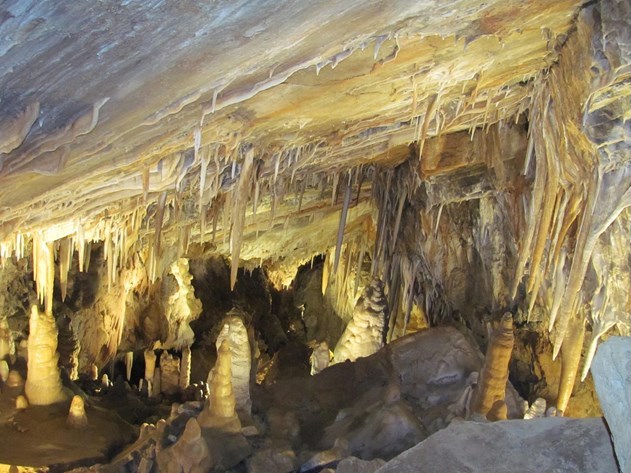
Stalactites that formed over thousands of years are found in Glenwood Caverns. The moist cave environment is preserved by airlock entries. Thousands of visitors visit Glenwood Caverns every year.

A site map prepared for Rocky Mountain Resources (later known as Rocky Mountain Industrials) in August 2019 for the proposed test water well drilling in the mine expansion area. Blue circles indicate the proposed drilling sites. The yellow line is an outline of the proposed mine expansion area of 321 acres. The entire permit area was proposed to be 447 acres.
Hot springs reports
Geophysical Investigation Report: Characterizing of Perimeter Area for Potential Karst Features
Nov. 13, 2018 (43 pages, 9.3 MB)
Collier Consulting Inc., Stephenville, Texas
Comments and concerns re: RMR proposed hydrologic baseline study and drilling program
Oct. 24, 2019 (13 pages, 1.9 MB)
BBA Water Consultants, Inc., Englewood, Colo., and West Sage Water Consultants, Denver
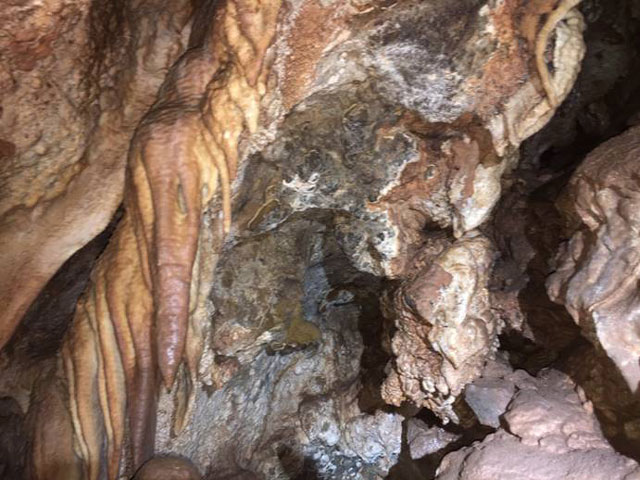
These hefty stalactites were discovered in the Witches’ Pantry Cave. It’s an unexplored cavern with an entry located inside the proposed mine expansion area. It was discovered in 2019 by members of the Colorado Grotto, a statewide organization of caving experts and explorers.
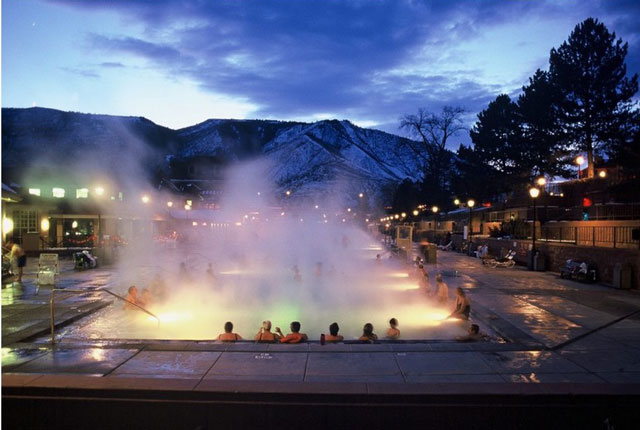
The Glenwood Hot Springs in late evening. The hot springs pool has attracted visitors to Glenwood Springs since 1888.
