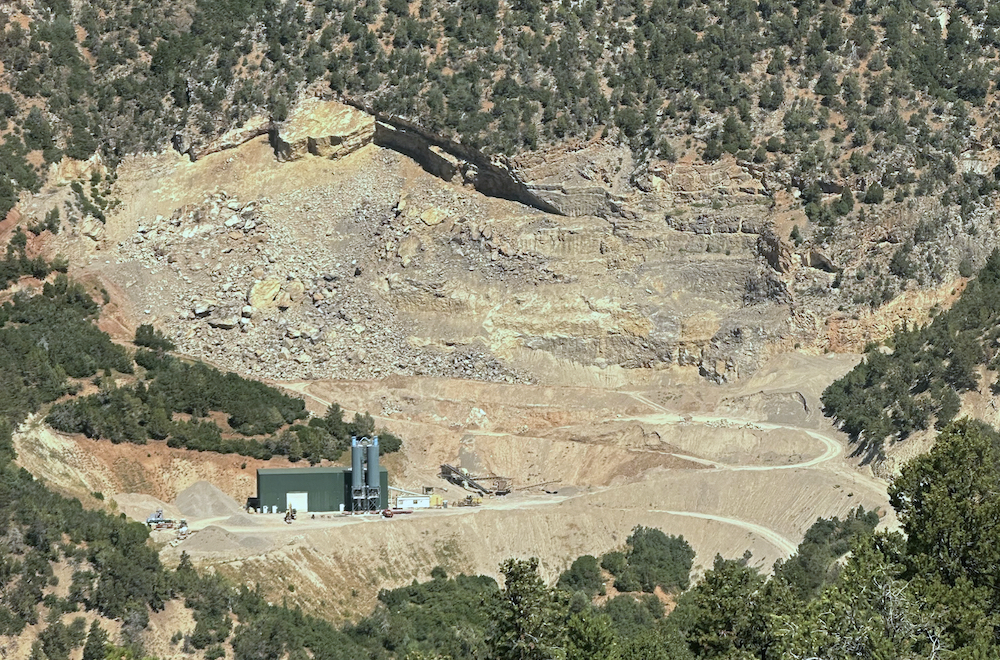
An overhanging cliff, 400 feet wide, casts a shadow above the limestone quarry operated by Rocky Mountain Industrials.
An increased state reclamation bond of nearly $1.2 million, approved in March 2026, would cover the cost of rock bolting along the top of the cliff to prevent further collapse.
Some milling and loading equipment seen in this photo has been removed from the site.
The Colorado Division of Reclamation, Mining and Safety (DRMS) has finalized a lengthy process to increase the reclamation bond for the Rocky Mountain Industrials limestone quarry operation near Glenwood Springs.
In February, DRMS and the mining company signed a stipulated agreement for an increased reclamation bond of $1,194,329. It was formally approved by the state Mined Land Reclamation Board on March 18. The new bond is an increase of $704,571 over the company’s previous bond of $489,758.
The higher bond amount will cover the estimated cost of installing rock bolts for 450 feet along the top of the overhanging cliff on the west highwall of the quarry. The cliff is the unstable remnant of a January 2023 rockslide, and rock bolting is the only means of securing the slope within RMI’s current quarry boundary of 38 acres.
According to a geotechnical report prepared by Kilduff Underground Engineering Inc. (link below), the seven-strand bolts would pin the unstable upper limestone layer, which is 10 to 15 feet thick, to the much thicker mass of limestone bedrock that lies below. The bolts would be drilled 30 to 45 feet down through the rock layers, and arrayed across the top of the cliff in a zig-zag pattern.
The previous bond amount covered standard quarry reclamation work. Reclamation bonds protect taxpayers from bearing the costs of reclamation if a mining company does not complete reclamation responsibilities after mine closure.
RMI prefers to mine upward, seeks new permit
Despite its submittals to the state, RMI has made clear that it has no intention of rock-bolting the cliff. In an Oct. 3, 2025, letter to DRMS, RMI Vice President Robert Wagner called the highwall rock bolting “an interim addition to the reclamation plan prior to a future amendment of the broader mining permit.”
RMI is aiming for an expansion of the quarry, starting with an upslope expansion from the current state-approved 38 acres to 56 acres. Approval of such a plan would enable RMI to mine upward on the slope, mining out the overhanging cliff and more of the slope above. However, RMI’s acreage under its federal/BLM permit is still limited to roughly 15 acres.
To that end, the company submitted proposed mining plans, with a 56-acre footprint, to the U.S. Bureau of Land Management in January 2025 and again in December 2025, according to Elizabeth Dawson, field manager for BLM’s Colorado River Valley Field Office. BLM rejected both proposals as incomplete, and therefore they were not accepted nor made public.
Dawson said Wagner has indicated that RMI will make yet another proposed mining plan submittal in the coming months. She noted that a proposal, once accepted, would go through a public review process managed by BLM.
The company’s 2018 proposal to expand the mine to 447 acres, taking it hundreds of feet up the mountainside and delivering many negative consequences to Glenwood Springs, remains in limbo. The economic case for the expansion took a hit in January 2025 when the U.S. Department of Interior ruled that most of the limestone to be mined must be purchased from the federal government from under a mineral sales contract, rather than mined freely as RMI proposed.
State upholds bond details, allows payment plan
At the state level, the reclamation bond is a key point of regulatory leverage. RMI and state officials have debated the bond price tag over the past year as the mining company made several attempts to reduce the bond amount.
First, it obtained bids for the rock bolting work that were significantly lower than those first estimated by DRMS staff. That brought the total bond down from an earlier estimate of $3.2 million to the current amount of nearly $1.2 million.
Later, the company fussed over inclusion of contractor profit, engineering work, bid preparation costs and a share of the bond that would be paid to BLM to cover the federal agency’s costs of managing a reclamation project. While DRMS officials met with Wagner to discuss these issues, state officials did not back down. DRMS insisted the costs were valid and refused to lower the bond amount.
Rocky Mountain Industrials then claimed a hardship in posting the entire increase amount within the usual 60-day period. DRMS conceded this point, and set up a five-part payment plan with due dates for payments starting May 1, 2026, and concluding on March 1, 2027.
Finalization of the reclamation bond amount and payment plan comes after a longer process to complete a narrative description of the rock bolting work, which started in late 2024 and concluded in November 2025. o
Documents
2026 Surety Increase No. 5 Stipulated Agreement
Rock Failure Analysis and Stability, Kilduff Underground Engineering Inc., Denver, Colo. Aug. 29, 2023. See pages 14-15 (pdf pp 17-18)